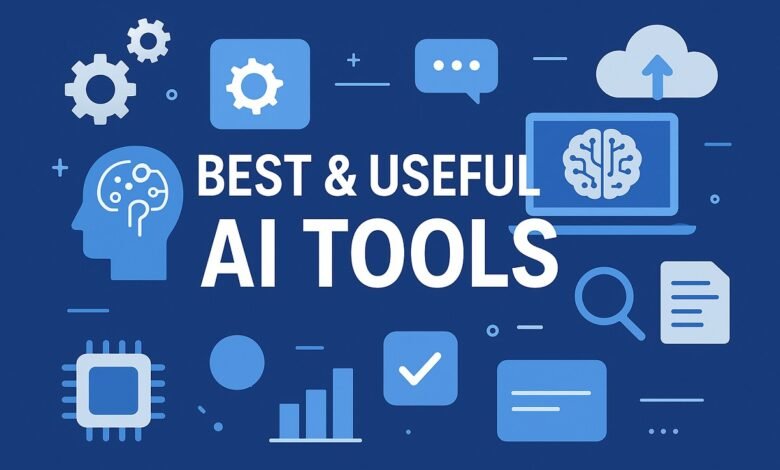
Artificial Intelligence has rapidly evolved from a futuristic concept into an essential part of modern business operations. Today, companies of all sizes are adopting AI tools to enhance productivity, optimize workflows, analyze data, and improve customer experiences.
The concept of AI tools has expanded across industries, empowering businesses to automate repetitive tasks, make faster decisions, and unlock new growth opportunities.
Understanding these AI-powered solutions is crucial for any organization that wants to remain competitive, especially as technology continues to advance at an unprecedented pace.
Why AI Tools Matter in Modern Businesses
AI tools are transforming how businesses function by simplifying complicated processes and enabling smarter decision-making. These tools assist in everything from marketing automation and content creation to customer support and data management. By blending human intelligence with machine precision, businesses can achieve higher efficiency and greater accuracy while reducing operational costs. Organizations embracing these tools are able to scale faster and deliver more personalized services, ultimately leading to improved revenue and stronger customer loyalty.
AI Tools Enhancing Daily Operations
AI is no longer used just for high-level strategic tasks; it is now deeply integrated into daily business activities. As per Forbes, These tools help companies automate emails, manage projects, schedule tasks, and streamline workflow coordination. This enables teams to focus on their core responsibilities instead of being overwhelmed by repetitive work. The increasing demand for productivity, speed, and accuracy has pushed companies to integrate AI into their organizational structure, ensuring smoother operations from top to bottom.
Tools Boosting Sales and Customer Interaction
With the help of AI-driven automation, businesses can now better understand customer behavior and market trends. These tools analyze purchasing patterns, predict customer needs, and assist in creating personalized marketing campaigns. Chatbots and virtual assistants improve customer service by providing instant support, while sentiment analysis tools help businesses understand customer emotions. The adoption of such AI solutions ultimately results in stronger relationships between businesses and their customers.
AI Tools Improving Data Accuracy and Decision-Making
Data has become the backbone of modern business strategy, and AI tools are essential for analyzing this data quickly and accurately. Advanced algorithms process massive datasets to uncover hidden insights and trends. These insights help businesses take informed decisions, reduce financial risks, and explore new opportunities. Industries such as finance, healthcare, logistics, and retail heavily rely on such tools to maintain accuracy and stay ahead of their competition.
AI Tools for Creative and Content Work
Beyond operations and analytics, AI tools have also become powerful partners in content creation and digital marketing. These tools assist in writing, editing, designing, video production, and creating social media content. They help businesses maintain a strong online presence with high-quality content that resonates with their audience. This not only saves time but also improves brand visibility and engagement across digital platforms.
Why These AI Tools Are Quietly Revolutionizing Businesses
Many of the AI tools being used worldwide are subtly transforming businesses without attracting much public attention. While some tools gain popularity, many work silently behind the scenes, making operations smoother and smarter. They are integrated into CRM systems, email platforms, content management systems, HR processes, and enterprise tools that companies use daily. Their impact becomes visible over time as businesses experience faster growth and improved performance across all departments.
Understanding the Most Useful AI Tools
The quiet revolution happening today is driven by tools that offer automation, enhancement, and deeper insights. These tools support marketing, customer service, content creation, project management, analytics, cybersecurity, HR, and even legal workflows. The versatility and adaptability of these tools make them essential for both small businesses and large enterprises.
AI Tools Empowering Marketing Teams
Marketing professionals use AI tools to manage campaigns, track analytics, and predict customer behavior. These tools automatically adjust ad spending, monitor traffic, and optimize marketing strategies based on real-time performance. They also help with keyword research, competitor analysis, and SEO improvements, making them vital for digital marketing agencies and in-house teams.
AI Tools Strengthening Productivity and Collaboration
Teams across the world rely on AI-based project management and collaboration tools to organize tasks, schedule meetings, and monitor progress. These tools are capable of analyzing workloads, forecasting timelines, and identifying risks before they become major issues. Their ability to integrate with other business systems ensures that team members remain aligned and informed at all times.
AI Tools Enhancing Customer Experience
Customer experience has become a core priority, and AI-driven tools help businesses offer fast, accurate, and personalized solutions. AI chatbots, automated helpdesks, and virtual assistants reduce waiting time and improve customer satisfaction. These tools also assist in gathering customer feedback and analyzing it to refine the company’s products and services.
AI Tools Advancing Human Resource Management
AI tools have made HR processes more efficient by automating applicant screening, resume parsing, employee performance tracking, and engagement analysis. They help HR teams ensure that staffing decisions are data-driven, unbiased, and strategically aligned. AI tools are also useful for training and development, identifying skill gaps, and recommending learning paths.
AI Tools Supporting Business Security and Risk Management
Cybersecurity tools powered by AI monitor unusual activities, protect systems from breaches, and detect vulnerabilities in real time. They help businesses safeguard sensitive information and ensure compliance with industry regulations. By detecting anomalies quickly, these tools help prevent financial loss and maintain organizational trust.

Conclusion
AI tools have become indispensable for today’s businesses, offering innovative solutions that enhance productivity, streamline processes, and improve data-driven decision-making. They operate quietly but effectively, powering different operations across marketing, sales, technology, customer service, and HR. As AI technology continues to develop, these tools will grow even more sophisticated, giving businesses new ways to innovate, scale, and compete in an increasingly digital world. Companies that embrace these AI solutions are not only staying ahead of competitors but are also shaping the future of global business operations.